Gujarat FDCA inspects 30+ medical stores and restricts suspected duplicate medicines worth ₹1.70 lakh.
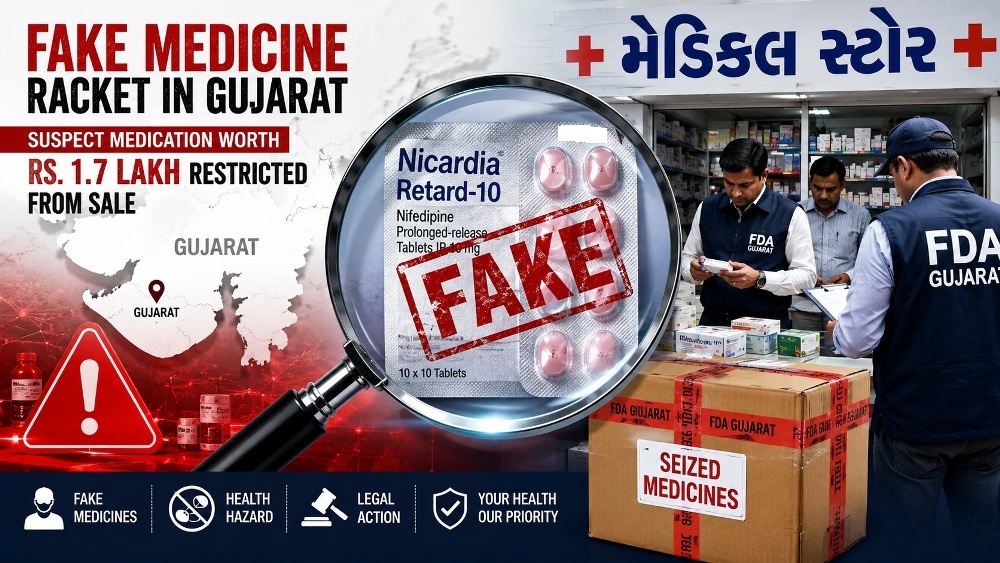
Gujarat FDCA Cracks Down on Suspected Fake Medicine Network, Seizes 1,250 Tablets Worth ₹1.70 Lakh, Over 30 medical stores inspected across multiple cities in ongoing investigation into suspected duplicate hypertension medication
Gujarat FDCA Takes Action Against Suspected Fake Medicines
The Gujarat Food and Drugs Control Administration (FDCA) has launched a major inspection drive against suspected fake, duplicate and illegally supplied medicines across Ahmedabad and other parts of the state.
The action follows information regarding the suspected circulation of duplicate Nicardia Retard-10 tablets, a medicine containing nifedipine and used in the management of high blood pressure. According to reports, more than 30 medical stores and agencies have been inspected during the ongoing investigation.
During the operation, 1,250 tablets of suspected duplicate Nicardia Retard-10 were seized from different locations. In addition, suspected medicine stock estimated at around Rs. 1.70 lakh has been restricted from sale pending further investigation and testing. ([The Indian Express][1])
The development has once again highlighted concerns around the Fake Medicines Racket and the movement of suspected duplicate medicines through pharmaceutical distribution channels.
Investigation Started After Information About Nicardia Retard-10
According to the information released in connection with the action, the investigation began after authorities received information regarding the possible sale of suspected duplicate NICARDIA RETARD 10 TABLETS, bearing Batch No. ACG25007.
The medicine was shown as being manufactured by J.B. Chemicals & Pharmaceuticals Ltd., Bharuch. Based on the information received, the FDCA began inspections in Ahmedabad and other locations from August 19, 2026.
The investigation is not limited to a single retail outlet. Authorities have been checking different points in the distribution chain to understand how the suspected medicine reached various medical stores and agencies.
This approach is important because identifying only the retail seller may not reveal the complete source of suspected counterfeit or duplicate medicines.
1,250 Suspected Duplicate Tablets Seized
One of the significant findings during the inspection was the recovery of 660 Nicardia Retard-10 tablets from a medical store in Nadiad.
The tablets were reportedly bearing the manufacturer details of J.B. Chemicals & Pharmaceuticals Limited, Bharuch and carried Batch No. ACG25007. The seized stock was taken as a regulatory sample and sent for testing.
Another 590 tablets of the same suspected medicine were seized from a supply chain involving medical agencies in Ahmedabad and Bhavnagar.
Together, these two recoveries account for 1,250 tablets.
The samples are being examined to establish their authenticity and quality. Therefore, it is important to note that the term "fake" or "duplicate" in this report refers to the suspected status reported during the regulatory investigation, rather than a final laboratory finding.
Around Rs. 1.70 Lakh Worth of Suspected Medicines Restricted
The investigation also uncovered other medicine stocks that authorities considered suspicious.
Apart from Nicardia Retard-10, samples of different batches of the following medicines were reportedly taken:
· Nicardia Retard 20 Tablets
· Cilacar 5 Tablets
· Cilacar 10 Tablets
· Cilacar TM 50 Tablets
· Nicardia Retard 10 Tablets
The concerned stocks, estimated at approximately Rs. 1.70 lakh, have been restricted from sale while the investigation and testing process continues. ([Mumbai Samachar][2])
Restriction from sale is an important regulatory step because it prevents potentially problematic stock from continuing into the market while authorities verify its identity, quality and source.
Suspected Distribution Chain Under Investigation
The investigation has also indicated a possible supply chain through which the suspected medicine moved.
According to the information provided by the authorities, the suspected route includes multiple intermediaries starting from a supplier based outside Gujarat and moving through various distribution points in Ahmedabad and surrounding areas.
The authorities are reportedly checking purchase and sales records of the concerned firms to establish the movement of the medicines.
Tracing the distribution chain can help regulators determine whether the issue originated with a supplier, distributor, intermediary or another point in the pharmaceutical supply network.
More Than 30 Medical Stores and Agencies Checked
The Gujarat FDCA's investigation has extended beyond Ahmedabad.
More than 30 medical stores and pharmaceutical agencies have reportedly been inspected during the ongoing operation. Investigations have also been conducted at locations in Ahmedabad, Surat, Bhuj and other parts of Gujarat. ([The Indian Express][1])
The inspection process is reportedly still underway, with authorities examining records and taking samples from various establishments across the state.
Why the Fake Medicines Racket Is a Serious Concern
The circulation of suspected duplicate medicines is a serious concern for the healthcare system because patients and healthcare professionals depend on medicines meeting established standards of identity, strength, quality and safety.
A genuine medicine is manufactured under controlled conditions and passes through defined quality-control procedures. A suspected duplicate product may not have the same assurance regarding its ingredients, strength, manufacturing process, stability or storage conditions.
This becomes particularly important when the medicine is intended for chronic conditions such as hypertension, where patients may take the same medicine regularly.
The current investigation involving Nicardia Retard-10 has therefore attracted attention not only because of the quantity seized but also because of the need to understand how suspected duplicate stock entered the legitimate pharmaceutical distribution network.
Duplicate Medicines Suppliers Under the Scanner
One of the important aspects of the investigation is the examination of suppliers and distributors.
Authorities are checking purchase invoices, sales records and other transaction details to establish the source and movement of the suspected medicines.
For pharmaceutical businesses, proper documentation and traceability are essential. A clear record of where medicines were purchased, when they were received and where they were supplied can help regulators quickly identify problematic batches.
The investigation into the Duplicate medicines suppliers involved in the suspected chain may therefore provide important information about how such products are entering the market.
Low-Quality Duplicate Medicines Can Create Additional Risks
Consumers sometimes choose medicines based on availability or price. However, unusually low prices or unexplained discounts can sometimes warrant additional verification.
Recent reports from Gujarat have also raised questions about unusual discounts associated with Nicardia Retard products, although such pricing differences alone do not establish that a medicine is counterfeit or duplicate. A separate report said Gujarat authorities had taken samples from a much larger number of distributors as part of an ongoing investigation. ([Gujarat First][3])
For this reason, patients should not assume that a lower-priced medicine is automatically fake. At the same time, medicines obtained from unknown or unauthorised sources can carry avoidable risks.
What Patients Should Check Before Buying Medicines
Patients can take a few simple precautions when purchasing prescription medicines:
Buy Medicines From Licensed Pharmacies
Whenever possible, medicines should be purchased from a legitimate and licensed pharmacy rather than an unknown seller or unauthorised online source.
Check the Packaging
Consumers should check the medicine's:
· Brand name
· Manufacturer details
· Batch number
· Manufacturing date
· Expiry date
· MRP
· Packaging condition
Damaged, altered or suspicious-looking packaging should be brought to the attention of the pharmacist.
Keep the Bill
Patients should retain the purchase bill, particularly for prescription medicines and long-term treatments. A bill can help establish the source of the medicine if a quality or authenticity concern later arises.
Do Not Stop Essential Medicines Without Medical Advice
If a patient becomes concerned about a particular medicine because of a news report, they should speak to their doctor or pharmacist rather than abruptly stopping treatment.
The current Gujarat investigation concerns specific suspected batches and stocks under regulatory examination. It should not be interpreted as a reason to stop all medicines containing the same active ingredient.
Investigation May Extend Further
The Gujarat FDCA is reportedly continuing its investigation and checking purchase and sales records of the concerned businesses.
Authorities are also expected to trace the suspected supply chain further upstream. Depending on the findings, action may be taken against parties found to have violated applicable laws.
The investigation could therefore provide a clearer picture of whether the suspected duplicate medicines originated from a particular supplier or entered the legitimate supply chain through multiple intermediaries.
At this stage, laboratory examination and documentary verification remain important before drawing final conclusions about the authenticity and quality of the seized medicines.
A Reminder About Pharmaceutical Supply-Chain Compliance
The case also highlights the importance of strong pharmaceutical supply-chain controls.
Manufacturers, stockists, distributors, wholesalers and retailers all have an important role in ensuring that medicines entering the market are sourced through authorised channels and maintained under appropriate conditions.
Proper invoices, batch-level traceability, supplier verification and stock reconciliation can help businesses identify irregularities at an early stage.
For pharmaceutical companies and distributors, compliance is not only a regulatory requirement but also an important part of maintaining patient safety and confidence in the medicine supply chain.
Conclusion
The Gujarat FDCA's ongoing action against suspected duplicate medicines has brought renewed attention to the Fake Medicines Racket and the risks associated with unauthorised pharmaceutical supply chains.
More than 30 medical stores and agencies have reportedly been inspected, while 1,250 suspected duplicate Nicardia Retard-10 tablets were seized from two locations. In addition, suspected medicine stocks valued at approximately Rs. 1.70 lakh have been restricted from sale pending further investigation and testing. ([The Indian Express][1])
The authorities are continuing to trace the supply chain and examine purchase and sales records. Further action will depend on the outcome of regulatory testing and investigation.
For patients, the incident is a reminder to purchase medicines only through reliable and authorised channels and to remain alert to unusual packaging, unexplained sources or suspicious transactions.
Disclaimer
Disclaimer: This article is prepared for news and general information purposes based on publicly available online news reports and information provided in the referenced reports. The medicines and batches discussed above are described as suspected fake, duplicate or suspicious based on the ongoing regulatory investigation. Final conclusions regarding authenticity, quality or legal responsibility should be based on official laboratory reports and findings of the competent authorities. This article is not intended to provide medical advice. Patients should consult their doctor or qualified pharmacist regarding any medicine-related concerns.
Sources:
The Indian Express – Suspect medication worth Rs.1.7 lakh restricted from sale in Gujarat
Times Now – Gujarat fake medicine crackdown report
Published: 22 August 2026
Location: Gujarat, India
[1]: https://indianexpress.com/article/cities/ahmedabad/gujarat-fdca-seizes-fake-hypertension-medication-ahmedabad-bharuch-10845149/?utm_source=chatgpt.com "Suspect medication worth Rs.1.7 lakh restricted from sale in Gujarat"
[2]: https://bombaysamachar.com/news/fake-medicine-network-busted-in-ahmedabad-30-medical-stores-searched-1250-pills-seized?utm_source=chatgpt.com "અમદાવાદમાં નકલી દવાનું નેટવર્ક પકડાયું: 30 મેડિકલ સ્ટોરમાં તપાસ, 1250 ગોળીઓ જપ્ત"
[3]: https://www.gujaratfirst.com/top-news/duplicate-heart-medicine-in-the-state-including-ahmedabad-food-and-drugs-department-takes-action/334206/amp/?utm_source=chatgpt.com "Duplicate Heart Medicine: હાર્ટની દવા પણ નકલી! - Gujarat First"
Disclaimer: This article is published for general news and informational purposes only and is based on information available through publicly accessible online news reports, official statements and other referenced sources. greencrossindia.com does not claim independent verification of the information reported in this article and is not responsible for any errors, omissions, inaccuracies, changes in facts, or consequences arising from reliance on the information presented.
The medicines, companies, batches and individuals mentioned in this article are discussed strictly in the context of the reported regulatory investigation. References to suspected fake, duplicate, counterfeit or low-quality medicines do not represent a final determination unless confirmed by the competent regulatory authority or through an official laboratory report.
greencrossindia.com is not responsible or liable for any direct or indirect loss, damage, medical decision, business decision, legal consequence or other action taken based on the contents of this article. Readers are advised to verify important information through official government sources, regulatory authorities, manufacturers or other authorised sources before relying upon it.
This article does not constitute medical, legal, regulatory or professional advice. Patients should consult a qualified doctor or pharmacist regarding any medicine-related concerns.
INFORMATIVE NEWS ARTICLE