Pharma News India Weekly: Export Crisis, GLP-1 Drug Race & Major Pharma Approvals
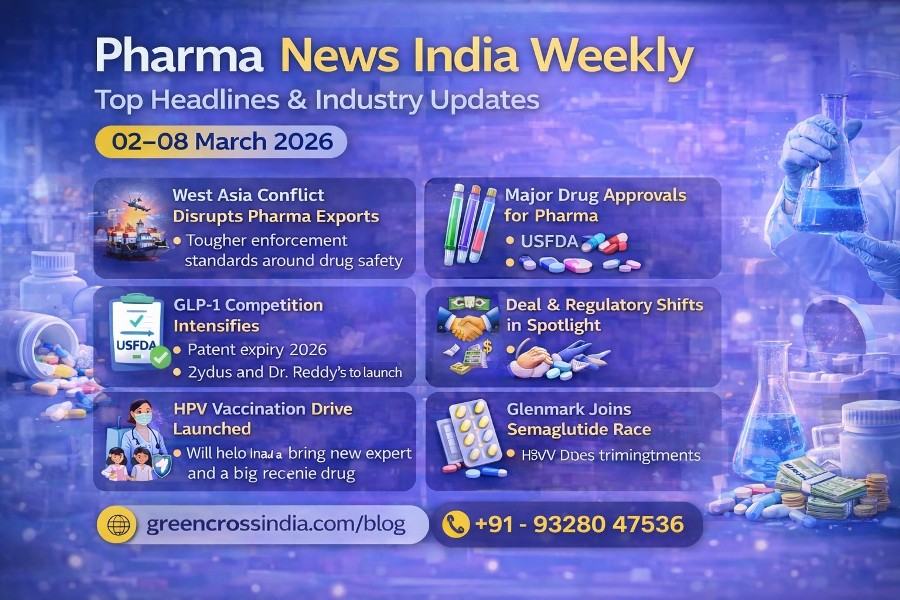
Pharma News India Weekly: Top Headlines & Industry Updates (02–08 March 2026)
📅 Published Date:08-03-2026
The week of March 2–8, 2026, was a period of significant contrast for the Indian pharmaceutical industry. While the sector showcased its strength through strategic partnerships, innovative research, and a robust pipeline of new drugs, it simultaneously grappled with a major external shock: the escalating conflict in West Asia.
This geopolitical crisis has disrupted supply chains, threatened billions in exports, and forced companies and the government into crisis management mode. From the red-hot GLP-1 market to groundbreaking advancements in gene therapy, here are the week’s top stories.
Summary: Key Takeaways from the Week
West Asia Conflict Disrupts Pharma Exports: The Iran–Israel–US conflict has severely impacted logistics, doubling freight costs and threatening ₹2,500–5,000 crore in March exports. The government has stepped in with an inter-ministerial group to support affected exporters.
GLP-1 Market Heats Up: The race for the weight-loss and diabetes drug market intensified with Glenmark set to join the generic semaglutide launch, while Eli Lilly defended its premium pricing for Mounjaro amid looming competition.
Innovation and R&D Take Center Stage: India's push towards becoming a global innovation hub was highlighted by the Biopharma Shakti programme, insights from global experts on AI in drug discovery, and a new GCC from Swiss CDMO giant Lonza in Hyderabad.
Public Health in Focus: A nationwide HPV vaccination drive for adolescent girls was launched, while a study confirmed the Indian HPV vaccine Cervavac is being tested for a single-dose regimen.
Strategic Moves and Regulatory Shifts: Key deals like Emcure's pact with Roche and new drug approvals (Aurobindo, Glenmark) were announced, alongside regulatory decisions on API pricing and third-party plant inspections.
West Asia Conflict: Pharma Sector Braces for Major Disruption
The biggest story of the week is the unfolding crisis in West Asia, which has thrown India's pharmaceutical supply chains into turmoil.
The conflict, which escalated on February 28, has led to the closure of key sea lanes like the Strait of Hormuz and disrupted air routes, with a direct and severe impact on the pharma sector.
Heavy Financial Impact Looming
Industry bodies and experts have quantified the potential damage.
The Pharmaceuticals Export Promotion Council of India (Pharmexcil) warned that a complete disruption of March exports could result in a loss of ₹2,500 crore to ₹5,000 crore.
This is because GCC countries and the WANA (West Asia–North Africa) region account for nearly 5.6% of India's total pharma exports, a market that was on an upward trajectory, reaching $1.75 billion in FY25.
Pharmexcil Chairman Namit Joshi noted that the doubling of freight charges and surcharges of $4,000–8,000 per shipment are putting immense pressure on companies.
Supply Chain in Turmoil
The logistical challenges are multi-faceted.
Freight costs for bulk drugs imported from China have doubled from $1,200 to $2,400 per container.
More worryingly, shipping lines are refusing cargo to Gulf hubs or imposing steep surcharges.
Experts pointed out that while most companies hold 3–6 months of inventory, the crisis jeopardises urgent, high-margin shipments that typically go by air.
“The air routes were used as a failsafe… Now they are getting costlier and also unreliable,” said Chandrachur Datta of Vector Consulting Group.
A contentious issue emerged where shipping lines demanded war-risk surcharges of up to $7,000 per container, even for goods that had already reached their destination ports.
Government Intervention
Recognising the gravity of the situation, the government swung into action.
Commerce and Industry Minister Piyush Goyal assured exporters that the government would use “every policy tool” to support them.
Key measures include:
Setting up an inter-ministerial monitoring group
Daily coordination with the shipping ministry
Meetings with exporters and logistics providers
Support for stuck cargo shipments
GLP-1 Race: Competition, Pricing, and Marketing
The Indian weight-loss and diabetes drug market remained a major focus this week, with several key developments in the GLP-1 agonist space.
Glenmark Joins the Semaglutide Fray
Glenmark Pharmaceuticals is set to join Sun Pharma, Dr. Reddy’s, and Zydus in launching a generic version of semaglutide after Novo Nordisk's patent expires on March 21.
Reports suggest Glenmark may price its product significantly lower than half the innovator's price and will differentiate itself with a comprehensive patient support programme.
Eli Lilly Stands Firm on Pricing
Amidst the impending generic wave for its rival molecule, Eli Lilly expressed confidence in its premium-priced drug Mounjaro (tirzepatide).
Winselov Tucker, President and GM of Eli Lilly India, stated:
“We are an innovative company with an innovative product, and we price based on the value delivered.”
He believes there is room for both innovator drugs and generics in the rapidly growing obesity and diabetes market.
Recent data showed Mounjaro has become India’s top-selling drug by monthly value.
Obesity Awareness Advertising Blitz
With strict rules prohibiting direct advertising of prescription drugs, pharma giants like Eli Lilly and Novo Nordisk have launched large-scale obesity awareness campaigns.
These campaigns:
Use celebrities and influencers
Promote obesity as a medical condition
Encourage early diagnosis and treatment
This is seen as a strategic effort to expand the market ahead of generic competition.
Innovation, R&D, and India's Global Role
Several developments this week highlighted India’s ambition to evolve from a generic drug powerhouse to a global innovation hub.
Biopharma Shakti and Clinical Research
The government’s ₹10,000 crore Biopharma Shakti programme was highlighted as a major catalyst for innovation.
Industry leaders like Satish Reddy (Dr. Reddy’s Laboratories) praised the initiative.
It will help India move from being a global supplier of quality medicines to a global innovator.
Meanwhile, Dr. Seema Pai, President of the Indian Society for Clinical Research, said India is emerging as a reliable technical engine for global clinical research.
AI's Transformative Role in Drug Discovery
In an exclusive interview, Professor Philip J. Young (University of Warwick) explained how AI technologies like AlphaFold2 are revolutionising drug discovery.
Key benefits include:
Reducing research timelines from decades to minutes
Solving complex protein structures
Accelerating drug development
He also highlighted India’s potential to lead affordable gene therapy innovations.
Global Capability Centre in Hyderabad
Swiss CDMO giant Lonza Group AG has selected Hyderabad to establish a new Global Capability Centre (GCC).
This move:
Strengthens Telangana’s life sciences ecosystem
Creates high-value employment
Reinforces Hyderabad’s global pharma leadership
Merck's Commitment to "Make in India"
Jean Charles Wirth, Global CEO of Merck Life Science, reaffirmed the company’s commitment to India.
The strategy focuses on:
Localised production
Global quality standards
Skill development
Support for global supply chains
Public Health: Vaccination Drives and Disease Trends
Public health developments also remained in focus.
Nationwide HPV Vaccination Campaign
The government launched a large-scale campaign to vaccinate 1.15 crore 14-year-old girls against cervical cancer.
The programme currently uses the Merck vaccine Gardasil-4.
However, the indigenous vaccine Cervavac is being tested for single-dose effectiveness, with results expected by 2027.
Alarming Health Data
Recent reports revealed concerning health trends:
India ranks second globally for childhood obesity, affecting 41 million children
Breast cancer incidence has more than doubled in the past 30 years
These findings underline the urgent need for preventive healthcare initiatives.
Corporate Developments, Approvals, and Regulatory News
Deals and Partnerships
Emcure Pharmaceuticals signed a distribution partnership with Roche.
The deal covers Roche’s nephrology and transplant medicine portfolio in India, including:
CellCept
Mircera
Major Drug Approvals
Aurobindo Pharma
Aurobindo subsidiary Eugia Pharma launched generic Pomalidomide Capsules in the US.
The drug targets a $3.3 billion oncology market.
Glenmark Pharmaceuticals
Glenmark received USFDA approval for Fluticasone Propionate inhaler.
The drug:
Treats asthma
Received Competitive Generic Therapy (CGT) status
Comes with 180 days of market exclusivity
Zydus Lifesciences
Zydus received USFDA approval for Ivermectin and Dapsone tablets, used to treat parasitic infections and leprosy.
Regulatory and Policy Updates
API Pricing Recovery Expected
India Ratings (Ind-Ra) predicts API prices may recover by FY27, driven by:
Minimum import price rules in India
Removal of VAT rebates in China
CDSCO to Engage Third-Party Auditors
To strengthen compliance checks, the Central Drugs Standard Control Organization (CDSCO) will appoint third-party certification bodies approved by the Quality Council of India.
This aims to address manpower shortages in regulatory inspections.
Stolen Insulin Alert
Authorities issued a nationwide alert after Sanofi’s Lantus SoloStar insulin consignment was stolen in Odisha.
Regulators warned that cold chain disruption could compromise drug safety.
International Pharma News (Global Developments)
Global pharma also recorded several clinical and regulatory breakthroughs.
New Drug Approvals
UK MHRA approved brensocatib for bronchiectasis
Imlunestrant tosylate approved for breast cancer
US FDA approved Sogroya for broader paediatric use
Promising Clinical Trial Results
Gilead reported strong HIV treatment outcomes
ViiV Healthcare’s Dovato reduced liver disease risk
J&J’s Tremfya showed sustained remission in ulcerative colitis
Early-Stage Innovation
HUTCHMED launched a global antibody therapy trial
Theolytics received funding for ovarian cancer research
Quell Therapeutics began trials for autoimmune CARTreg therapy.
FAQ: Weekly Pharma News Explained
What are the top pharmaceutical trends for 2026?
Key industry trends include:
- Geopolitical supply chain disruptions
- Rapid growth in GLP-1 obesity drugs
- AI-driven drug discovery
- India's shift toward innovation and biologics
- Expansion of preventive healthcare programs
What are the latest pharmaceutical news updates this week?
- The biggest updates include:
- West Asia conflict affecting pharma exports
- Generic semaglutide race intensifying
- Lonza setting up GCC in Hyderabad
- Nationwide HPV vaccination drive
- USFDA approvals for Glenmark, Aurobindo, and Zydus
What is happening in the pharmaceutical industry this week?
The sector is dealing with:
- Export disruptions due to geopolitical tensions
- Rising freight costs and logistics challenges
- Preparation for semaglutide patent expiry
- Rapid innovation and R&D investments
Where to find weekly pharma industry news?
For regular pharma industry updates, visit:
What were Sun Pharma's latest news this week?
- Sun Pharma was highlighted as one of the companies preparing to launch generic semaglutide after the patent expiry on March 21, positioning it strongly in the obesity drug market.
What are the key challenges for Indian pharma exporters right now?
Exporters currently face several major challenges:
- Rising freight costs
- Shipping restrictions to Gulf countries
- War-risk surcharges
- Disrupted air routes
- Raw material supply delays
Read Article on issu.com as pdf -
Disclaimer
This article is compiled from publicly available pharmaceutical industry news sources for informational purposes only. It does not constitute medical, legal, or financial advice.
APPLY FOR PCD PHARMA FRANCHISE